
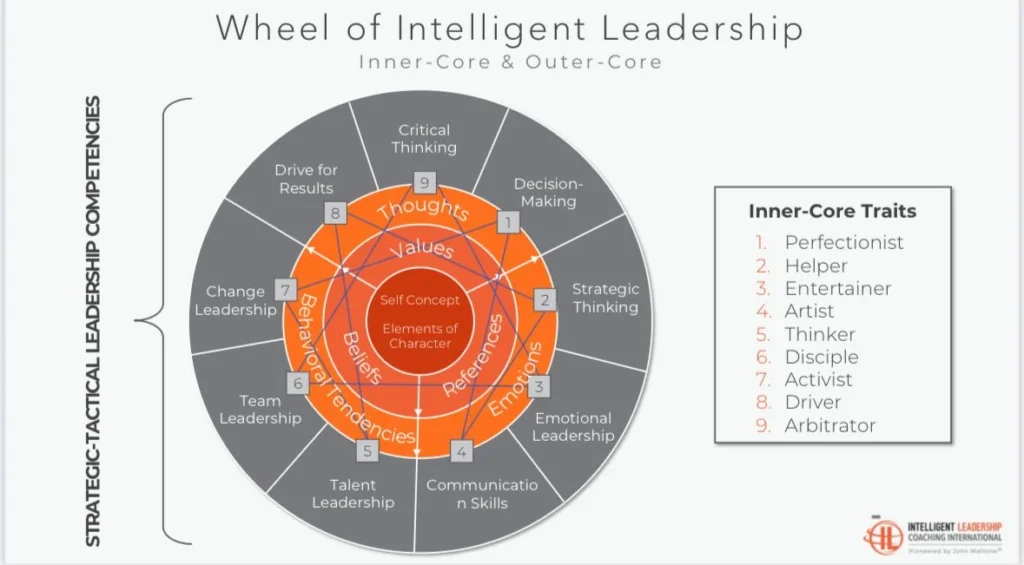
It only stands to reason that without leadership experience, most emerging leaders lead based on their own beliefs, values, self-concept, ingrained thinking patters and emotions or what I call their inner core.
But many young leaders aren’t aware of their inner core characteristics, even though they help define and shape each person’s unique leadership style. Those that do demonstrate self-awareness often struggle with what I call “self-regulation”, meaning they continue to act and behave ineffectively despite being aware of their ineffective tendencies. In other words, they are stuck!
Today’s organizations tend to expect individuals at all levels to be
leaders, and it’s certainly required if you want to thrive. But not everyone is ready and willing to take on the responsibilities of leadership that their companies need them to assume.
I use the Map of Leadership Maturity, which was first developed by John Mattone in 1996 as part of one of his earlier books, Success Yourself, and has continued to shape and refine the “Map” based on his work as a coach with leaders all over the world.
The Map of Leadership Maturity is the only Enneagram specifically designed to address current and emerging leadership development, growth, and maturity. Once you better understand your inner core
and potential, you will make wiser decisions, be more prepared to lead change, create teams, resolve conflict, and communicate in ways that will raise you to higher success levels. Benefits are experienced by you, your teams, and your organization as you become better able to understand others and build the strength and versatility that connects your inner core with your outer-core competencies and
beliefs.
Using “The Map” helps you identify your predominant leadership traits and then work to cultivate the most mature characteristics in them. When you’ve cultivated the mature characteristics of your predominant trait, you can work on developing the mature characteristics of all traits that define
outstanding leadership. To succeed, you will have to face and address unpalatable truths about yourself and work on ridding yourself of limiting thoughts, emotions and behaviors. But the results will be worthwhile due to gains in maturity and leadership capability. The Map of Leadership Maturity, distinguishes among nine leadership traits. Your inner core and behavioral tendencies are primarily associated with one predominant characteristic, but everyone demonstrates (to some extent) inner core characteristics and behavioral tendencies linked with other
traits too.
Each of the nine “Map” points corresponds to a singular way of thinking and feeling based on inner-core drivers such as self-concept, values and character and results in “behavioral tendencies” or potential to
act in a predictable way. The “Map” is less about personality and more about “tendencies” that spill over to leadership behaviors in the outer core. The three main leadership groupings in The Map are the
Heart, Head, and Gut. Everyone is guided by Heart, Head, and Gut to some degree, but people tend to exhibit characteristics in one of the groups more than the other two. The three main leadership groups
are each further refined into three groupings to make up all nine points on the “Map”.
Subdivisions of the Three Main Leadership Groupings
Heart, Head, and Gut are too broad to capture the complexity of leadership potential, so each is further
subdivided into three subtypes. Specifically:
• Heart: Helper Trait, Entertainer Trait, or Artist Trait
• Head: Activist Trait, Disciple Trait, or Thinker Trait
• Gut: Driver Trait, Arbitrator Trait, or Perfectionist Trait
As with the three main leadership categories, people tend to have the characteristics associated with
one subgroup more than others. Each subcategory differs in relation to the dominant trait of the leadership category, with one subcategory overdeveloping the trait, another under-developing it, and
the third out of touch with it. Each of these are at the root of a leader acting immaturely or in a derailing manner. For example:
• With the Heart, The Helper trait has overdeveloped feeling characteristics, while the Entertainer trait is out of touch with them and the Artist Trait has underdeveloped feeling characteristics.
• With the Head, The Activist trait has overdeveloped thinking characteristics while the Disciple trait is out of touch with thinking characteristics and the Thinker trait has underdeveloped ones.
• With the Gut, the Driver trait has overdeveloped Gut characteristics while the Arbitrator trait is out of touch with them and the Perfectionist trait has underdeveloped them.
But many young leaders aren’t aware of their inner core characteristics, even though they help define and shape each person’s unique leadership style. Those that do demonstrate self-awareness often struggle with what I call “self-regulation”, meaning they continue to act and behave ineffectively despite being aware of their ineffective tendencies. In other words, they are stuck!
Today’s organizations tend to expect individuals at all levels to be
leaders, and it’s certainly required if you want to thrive. But not everyone is ready and willing to take on the responsibilities of leadership that their companies need them to assume.
I use the Map of Leadership Maturity, which was first developed by John Mattone in 1996 as part of one of his earlier books, Success Yourself, and has continued to shape and refine the “Map” based on his work as a coach with leaders all over the world.
The Map of Leadership Maturity is the only Enneagram specifically designed to address current and emerging leadership development, growth, and maturity. Once you better understand your inner core
and potential, you will make wiser decisions, be more prepared to lead change, create teams, resolve conflict, and communicate in ways that will raise you to higher success levels. Benefits are experienced by you, your teams, and your organization as you become better able to understand others and build the strength and versatility that connects your inner core with your outer-core competencies and
beliefs.
Using “The Map” helps you identify your predominant leadership traits and then work to cultivate the most mature characteristics in them. When you’ve cultivated the mature characteristics of your predominant trait, you can work on developing the mature characteristics of all traits that define
outstanding leadership. To succeed, you will have to face and address unpalatable truths about yourself and work on ridding yourself of limiting thoughts, emotions and behaviors. But the results will be worthwhile due to gains in maturity and leadership capability. The Map of Leadership Maturity, distinguishes among nine leadership traits. Your inner core and behavioral tendencies are primarily associated with one predominant characteristic, but everyone demonstrates (to some extent) inner core characteristics and behavioral tendencies linked with other
traits too.
Each of the nine “Map” points corresponds to a singular way of thinking and feeling based on inner-core drivers such as self-concept, values and character and results in “behavioral tendencies” or potential to
act in a predictable way. The “Map” is less about personality and more about “tendencies” that spill over to leadership behaviors in the outer core. The three main leadership groupings in The Map are the
Heart, Head, and Gut. Everyone is guided by Heart, Head, and Gut to some degree, but people tend to exhibit characteristics in one of the groups more than the other two. The three main leadership groups
are each further refined into three groupings to make up all nine points on the “Map”.
Subdivisions of the Three Main Leadership Groupings
Heart, Head, and Gut are too broad to capture the complexity of leadership potential, so each is further
subdivided into three subtypes. Specifically:
• Heart: Helper Trait, Entertainer Trait, or Artist Trait
• Head: Activist Trait, Disciple Trait, or Thinker Trait
• Gut: Driver Trait, Arbitrator Trait, or Perfectionist Trait
As with the three main leadership categories, people tend to have the characteristics associated with
one subgroup more than others. Each subcategory differs in relation to the dominant trait of the leadership category, with one subcategory overdeveloping the trait, another under-developing it, and
the third out of touch with it. Each of these are at the root of a leader acting immaturely or in a derailing manner. For example:
• With the Heart, The Helper trait has overdeveloped feeling characteristics, while the Entertainer trait is out of touch with them and the Artist Trait has underdeveloped feeling characteristics.
• With the Head, The Activist trait has overdeveloped thinking characteristics while the Disciple trait is out of touch with thinking characteristics and the Thinker trait has underdeveloped ones.
• With the Gut, the Driver trait has overdeveloped Gut characteristics while the Arbitrator trait is out of touch with them and the Perfectionist trait has underdeveloped them.